Definitions of Vicat Softening Point and Heat Deflection Temperature
The Vicat softening point serves as an indicator for polymer quality control and for identifying the thermal performance of new‑grade polymers; it does not represent the service temperature of materials.
Heat Deflection Temperature (abbreviated HDT) is a parameter describing the relationship between heating and deformation of test specimens.
Vicat softening point: For specimens of engineering plastics, general‑purpose plastics and other polymers immersed in a liquid heat‑transfer medium, under specified load and constant heating‑rate conditions, it refers to the temperature when a 1 mm² flat‑tipped indenter penetrates 1 mm deep into the specimenISO.
Heat‑deflection temperature testing records the temperature at a specified load and specified deformation value.
Softening point: The temperature at which a substance softens. It mainly denotes the temperature at which amorphous polymers begin to soften. It depends not only on polymer structure but also on molecular weight. Multiple measurement methods exist, and results often differ between test methods. Widely‑used methods include the Vicat method and the ring‑and‑ball method.
Heat Deflection Temperature: The temperature at which a specimen deforms (or softens) to a defined magnitude under a given load.
Take a standard test bar as an example: under a defined heating rate and applied load, heat‑deflection temperature is the temperature corresponding to a specimen mid‑span deflection of 0.21 mm.
Vicat softening point: Under a defined heating rate and applied load, it is the temperature when the indenter penetrates 1 mm into a standard specimen. Two standard options are available for both heating rate and applied loadISO.
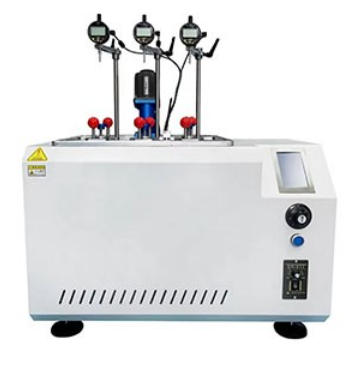
The Heat‑Deflection & Vicat Softening‑Point Tester adopts a PLC programmable controller for temperature regulation and is operated via computer control. It features simple operation, convenient use and stable performance. During testing, it can monitor test temperature and deformation in real time. Upon test completion, heating is automatically shut off. This series of instruments is ideal equipment for quality‑inspection institutions, universities, research institutes and manufacturing enterprises for in‑house inspection.
This instrument is mainly used to determine heat‑deflection temperature and Vicat softening‑point temperature for non‑metallic materials such as plastics, nylon and electrical‑insulating materials.
Product Advantages
- Intelligent PID regulation for accurate heating‑rate and precise temperature control.
- Supports heat‑deflection tests for all standard‑size test bars.
- Supports Vicat softening‑point tests for all standard‑size test bars.
- Automatically calculates required load according to test standards and specimen dimensions.
- Two heating‑rate options available for free switching; simple operation.
- Automatically disables temperature control upon test completion or over‑temperature limit.
- Built‑in software over‑temperature protection and electric‑leakage protection.
-