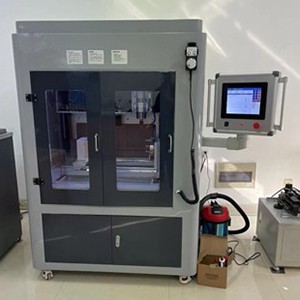
- ST-901-4
This machine ST-901-4 is a sample preparation equipment designed according to the principle of CNC milling and specialized for specimen required for plastic pipe material testing. You can select the machining type through the touch screen of the industrial computer and input corresponding parameters to process dumbbell specimens, long strip specimens, and circular specimens. This machine allows an
Product Description
This machine ST-901-4 is a sample preparation equipment designed according to the principle of CNC milling and specialized for specimen required for plastic pipe material testing. You can select the machining type through the touch screen of the industrial computer and input corresponding parameters to process dumbbell specimens, long strip specimens, and circular specimens. This machine allows an automatic thinning of materials.
This machine can make dumbbell splines for tensile tests, strip splines for impact and bending tests, splines for heat deflection temperature tests, square splines for Vicat temperature tests, circular specimens, and other special shape specimens.
This machine is composed of three coordination axes (X, Y, Z) and a rotation axis. The three coordination axes are responsible for milling cutter positioning, and the rotation axis is responsible for rotating the material, to realize automatic sampling in each direction of the pipe and to prepare multiple specimens of different shapes on the material at one time.
Equipment structure
This machine adopts a 4-axis structure,
which expand A axis on Y axis. The three-dimensional machining is realized
through the collaboration of X axis, Y axis and Z axis. The A-axis drives pipe
rotation and realize automatic machining along the axial and circumferential
direction of the pipe.
The self-designed ultra-thin
stainless-steel plate (patented product) allows the installation of φ50-φ400
pipe. The stainless-steel plate is designed to be adapted to humid,
water-cooled environment.
The double brake Y-axis loading mechanism
(patented product) ensures stable material clamping during processing and
ensure processing quality.
This machine is equipped with a high-speed
spindle motor and a milling cutter that is suitable to cut polymer materials,
providing an unhindered cutting, a smooth debris discharge during processing,
less heat and non-stick blade.
This machine uses the three-axis proximity
limit switch. The machine will restore to the zero mode and automatically reach
the designated position when it starts. The position of the X-axis limit switch
can be adjusted to avoid collision accidents caused by the machining graphics
size exceeding the material size.
Water-cooled components are equipped. The
water-cooling device can be leveraged during the machining process to spray and
cool the material as needed.
This machine is equipped with an electronic
handwheel for precise position adjustment. The spindle motor position can be
easily adjusted by the crank handle.
An industrial computer with touch screen is
leveraged to enable interaction. The self-designed control board is stable and
has strong anti-interference capability, with the protection of multi-level
isolation to prevent from interference signals and the advantage an optimized
protocol to communicate with the industrial computer.
Software introductions
1. Dumbbell spline
The system has built-in dumbbell-shaped
graphics specified by common international standards and national standards.
This machine can conduct a variety of processing methods, such as processing
along the dumbbell-shaped contour at one time, or processing two parallel parts
of the dumbbell first and then processing two sections of the dumbbell.
If you have special processing needs, it’s
easy to learn how to compile dumbbell processing model files (a very simple
combination of instructions). You can also contact the manufacturer to make
processing model files for free.
The machine provides a thinning option before going into the machining process. If selected, the operations of thinning and processing are automatically completed.
2. Rectangular spline
Choose to produce rectangular spline in the
software and input the length and width required. Since the milling cutter
occupies a certain width, you can choose whether the input dimension is an
outer or inner contour. Rectangular splines are usually used for impact test
and Vicat test.
The machine provides a thinning option
before going into the machining process. If selected, the operations of
thinning and processing are automatically completed.
3. Circular spline
Choose to produce circular spline in the
software and input the radius required. Since the milling cutter occupies a
certain width, you can choose whether the input dimension is an outer or inner
contour. Circular splines are usually used for special test and Vicat test.
The machine provides a thinning option
before going into the machining process. If selected, the operations of
thinning and processing are automatically completed.
4. Customization
You need to write a model file if you want
to produce customized splines. A model file usually includes 5 instructions to
control the equipment to complete processing, together with parameter settings.
The file writing is easy to learn and use. Welcome to contact us for free
training if you are interested. For customers who use it occasionally, we
recommend you give the graphic to the manufacturer, and our technical staff
will write the file for free.
5. Thinning function
The thinning function equipped can mill the
pipe to a certain thickness. This function can be selected before machining
dumbbell, rectangular and circular splines. It can perfectly match the thinning
requirement for thick pipe materials to conduct impact tests.
Note: The thinning process is conducted on
the outer wall of the pipe and is unavailable to be carried out on the inner
wall due to the structural design.
6. Producing multiple specimens at one time
The software can add multiple arbitrary
graphics along the axial and circumferential direction of the pipe, such as
adding 3 8804-2 standard dumbbell shapes, adding 4 8804-3 standard dumbbell
shapes, and then adding 5 rectangles, etc. During the process, you need to
choose whether to distribute them axially or circumferentially along the pipe.
You can start machining after setting the graphics, and the specimens will be
produced at one time. (Provided that the intercepted pipe segment can
accommodate these specimens)
7. Parameters setting
To reduce operation complexity, the
software only provides a few necessary data settings for adjustment, and the
rest are automatically generated by the system. The main parameters include
material thickness, pipe outer diameter, cutter blade diameter, cutter passing
speed, connection point width and thickness, layer depth, etc.
|
No. |
Parameter Name |
Technical Specification |
|
1 |
Number of moving axes |
4 axes (X, Y, Z, A) |
|
2 |
Maximum moving speed |
500 mm/min |
|
3 |
Minimum moving speed |
10 mm/min |
|
4 |
Spindle positioning accuracy |
0.02 mm |
|
5 |
X-axis travel |
550 mm |
|
6 |
Y-axis travel |
350 mm |
|
7 |
Z-axis travel |
220 mm |
|
8 |
A-axis travel |
360° |
|
9 |
Spindle power |
2.2 KW |
|
10 |
Spindle speed |
24000 RPM |
|
11 |
Spindle cooling method |
Water cooling |
|
12 |
Cutter diameter |
φ6 mm, φ3.175 mm |
|
13 |
Material cooling method |
Natural cooling, water cooling |
|
14 |
Max. diameter of processed pipe |
400 mm |
|
15 |
Max. length of processed pipe |
530 mm |
|
16 |
Max. wall thickness of processed pipe |
50 mm |
|
17 |
Overall machine dimension |
1397 × 680 × 1473 mm |
|
18 |
Power supply |
220V±10%, 3000W |
|
19 |
Main unit weight |
Approx. 480 kg |